
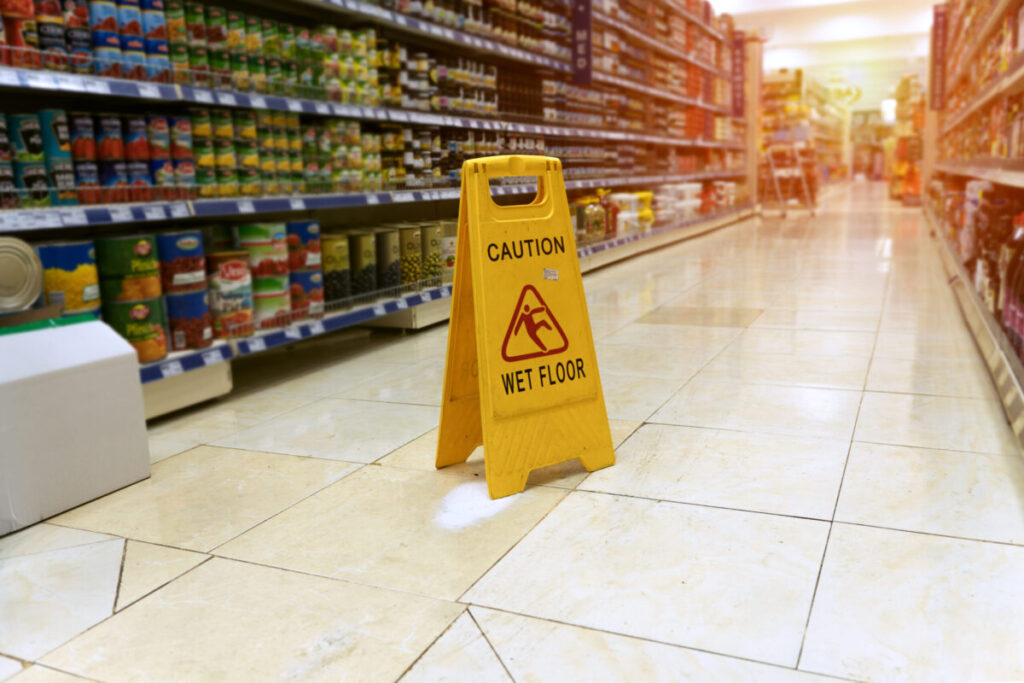
Yes, you can sue a grocery store, supermarket, retail store, or other business in California if you were injured in a slip and fall accident caused by the store’s negligence. Under California premises liability law, including Civil Code § 1714, stores have a legal duty to maintain reasonably safe conditions for customers. If you slipped on a wet floor, spilled liquid, food, cleaning solution, loose merchandise, damaged flooring, an unsecured floor mat, or another dangerous condition, the store may be legally responsible if its employees created the hazard, knew about it, or reasonably should have discovered and corrected it or provided an adequate warning. Simply falling inside a store does not automatically establish liability. However, if negligence caused your injuries, you may be entitled to compensation for medical bills, lost wages, pain and suffering, surgery, future medical treatment, and permanent disability. If you were seriously injured in a California store, seek medical attention, report the accident to management, photograph the dangerous condition, identify witnesses, and request that surveillance footage and incident records be preserved. The Law Offices of Gerald L. Marcus, a Los Angeles County personal injury law firm representing injured Californians since 1987, helps slip and fall accident victims investigate store negligence, establish premises liability, challenge insurance company disputes, and pursue the maximum compensation available under California law. If you suffered a slip and fall injury at a store in Los Angeles, Orange County, or anywhere in Southern California, call 818-784-8544 for a free consultation to discuss your legal rights and potential compensation.
Can You Sue a Store After a Slip and Fall in California?
Yes—but the key question is not simply where you fell.
The real question is:
Did the store fail to use reasonable care to keep the property safe?
A strong store slip and fall claim may exist when:
- A dangerous condition existed.
- The store created the dangerous condition.
- An employee knew about the condition.
- The condition existed long enough that reasonable inspections should have discovered it.
- The store failed to correct the danger.
- The store failed to provide an adequate warning.
- The dangerous condition caused your fall.
- You suffered actual injuries and damages.
California’s official civil jury instructions explain that premises liability can involve defendants who owned, leased, occupied, or controlled the property and negligently used or maintained it.
This is why a slip and fall case is fundamentally an evidence case.
You do not win simply because you fell.
You build the case by proving why you fell and why the store should have prevented it.
What Do You Have to Prove in a California Store Slip and Fall Case?
A successful claim generally requires evidence establishing several important points.
1. The Store Controlled the Property
The defendant may be the store itself, property owner, shopping center operator, maintenance contractor, cleaning company, or another party responsible for the area where you fell.
Control matters because premises liability is tied to the ability to manage and maintain the property.
2. A Dangerous Condition Existed
There must ordinarily be something about the property that created an unreasonable risk of harm.
Examples include:
- liquid on a floor
- food or produce in an aisle
- leaking refrigeration equipment
- damaged flooring
- loose mats
- broken stairs
- dangerous parking lot conditions
- inadequate lighting
- objects blocking walkways
3. The Store Knew or Should Have Known About It
This is often the biggest fight in the entire case.
The store may argue:
“We didn’t know it was there.”
That does not necessarily end the case.
The question can also be whether reasonable inspections should have discovered the danger before you were hurt.
4. The Store Failed to Act Reasonably
Depending on the circumstances, reasonable action might include:
- cleaning a spill
- repairing a defect
- blocking off the area
- providing an effective warning
- inspecting the area
- addressing a recurring problem
5. The Dangerous Condition Caused Your Injuries
You must connect the negligence to both the fall and your injuries.
That is why medical treatment and documentation are important.
What Does California Premises Liability Law Say?
California Civil Code §1714 establishes a broad rule of responsibility for injuries resulting from a lack of ordinary care in managing property or one’s conduct.
For an unsafe property condition, California’s 2026 civil jury instructions state in substance that negligence may exist where:
- A condition created an unreasonable risk of harm;
- the defendant knew or should have known about the condition through reasonable care; and
- the defendant failed to repair it, protect against it, or adequately warn about it.
In plain English:
Stores must take reasonable steps to keep customers reasonably safe.
They are not required to guarantee that no accident will ever happen.
But they cannot ignore hazards that reasonable store operations and inspections should identify and address.
What Does It Mean That a Store Knew or Should Have Known About the Hazard?
This issue is commonly called notice.
There are two important concepts.
Actual Notice
Actual notice means the store actually knew about the dangerous condition.
Examples could include:
- An employee saw the spill.
- A customer reported the hazard.
- An employee created the condition.
- Management received an earlier complaint.
- Employees had already placed equipment near the area.
- Video shows employees walking past the hazard.
Constructive Notice
Constructive notice can become an issue when the store claims nobody actually knew about the danger.
The question becomes whether the condition existed long enough—or the circumstances were such—that a reasonably careful store should have discovered it.
That makes evidence regarding inspection procedures and timing extremely important.
Potential evidence includes:
- floor inspection logs
- cleaning schedules
- employee assignments
- surveillance footage
- sweep sheets
- witness testimony
- earlier complaints
- maintenance records
The longer a hazard existed without being addressed, the stronger a constructive-notice argument may become depending on the evidence.
Common Hazards That Cause Store Slip and Fall Accidents
Slip and falls occur throughout California retail environments.
Common dangerous conditions include:
- Water on the floor
- Spilled drinks
- Milk or other liquids
- Produce on grocery-store floors
- Cooking oil or grease
- Leaking refrigerators or freezers
- Recently mopped floors
- Rainwater near entrances
- Loose or curled floor mats
- Torn carpeting
- Broken tiles
- Uneven flooring
- Merchandise in aisles
- Cardboard or plastic packaging
- Pallets and stocking equipment
- Poorly maintained stairs
- Defective handrails
- Poor lighting
- Potholes
- Dangerous parking lots
- Broken pavement
A recurring problem can be especially important.
For example, if refrigeration equipment repeatedly leaked in the same aisle, evidence showing previous leaks, complaints, repairs, or cleanup incidents could potentially help establish that the store knew the area required attention.
What Should You Do Immediately After Falling in a Store?
If you are physically able, take these steps.
1. Get Medical Care
Your health comes first.
Do not assume you are fine simply because you can stand or walk.
Some injuries become more obvious after the adrenaline of the accident wears off.
2. Report the Accident
Tell a manager what happened.
Ask that the incident be documented.
Get the manager’s name.
3. Photograph the Hazard
Take close-up and wide-angle photos.
Do not photograph only your injury.
Photograph what caused you to fall.
4. Record Video
Video can capture the size of the area, lighting, location of warning signs, store layout, leaking equipment, footprints, cart tracks, or other useful details.
5. Get Witness Information
Ask witnesses for:
- name
- phone number
- email address
An independent witness can become extremely important if the store later disputes what happened.
6. Save Your Receipt
A receipt, payment record, or loyalty-account transaction may help establish when you were inside the store.
7. Preserve Your Shoes and Clothing
Do not immediately discard shoes or clothing connected to the fall.
8. Be Careful What You Say
Avoid statements such as:
- “I’m fine.”
- “It was my fault.”
- “I wasn’t watching.”
- “I’m not injured.”
- “I should have seen it.”
Give accurate factual information without guessing.
9. Talk to a Lawyer Before Giving a Recorded Insurance Statement
The store’s insurer will investigate liability.
You should understand your rights before providing a detailed recorded statement.
What Evidence Can Prove a Store Was Negligent?
Evidence can make the difference between a disputed claim and a strong premises-liability case.
Important evidence may include:
- Surveillance footage
- Cellphone photos
- Videos
- Witness statements
- Incident reports
- Inspection logs
- Cleaning records
- Employee schedules
- Maintenance records
- Prior complaints
- Repair records
- Work orders
- Store policies
- Safety procedures
- Employee testimony
- Medical records
- Ambulance records
- Receipts
- Clothing and footwear
- Expert analysis where appropriate
One of the most important questions is often:
How long was the dangerous condition there before you fell?
A photo taken seconds after the accident might show more than simply a puddle.
It might show:
- dirty water
- footprints
- shopping-cart tracks
- debris
- partially dried areas
- evidence of a continuing leak
Details like these can become important when reconstructing what happened.
What Injuries Can Lead to a Slip and Fall Lawsuit?
A store fall can cause far more than temporary soreness.
Common serious injuries include:
Broken Bones
Falls frequently injure:
- wrists
- arms
- ankles
- legs
- hips
- pelvis
- shoulders
Some fractures require surgical repair with plates, screws, rods, or other hardware.
Head Injuries and Traumatic Brain Injuries
A person’s head may strike:
- concrete
- tile
- shelving
- displays
- another hard surface
Even a fall from standing height can cause significant head trauma.
Back and Spinal Injuries
Falls may cause or aggravate:
- herniated discs
- nerve compression
- vertebral injuries
- chronic back pain
- radiculopathy
Knee Injuries
A twisting fall may damage the meniscus, ACL, MCL, cartilage, or other structures.
Shoulder Injuries
Trying to catch yourself can cause rotator-cuff tears, fractures, dislocations, and other shoulder injuries.
Hip Injuries
Hip fractures can be particularly serious and may require surgery and extensive rehabilitation.
What Compensation Can You Recover?
If store negligence caused your injuries, recoverable damages may include financial losses and the personal impact the accident has had on your life.
| Economic Damages | Non-Economic Damages |
|---|---|
| Emergency room bills | Physical pain |
| Hospital bills | Emotional distress |
| Surgery | Loss of enjoyment of life |
| Diagnostic imaging | Inconvenience |
| Physical therapy | Physical limitations |
| Future medical treatment | Disfigurement |
| Prescription medication | Permanent effects |
| Lost wages | Reduced quality of life |
| Loss of earning capacity | Mental suffering |
The value of a slip and fall case depends heavily on the specific facts.
Important factors include:
- How severe your injuries are
- Whether surgery is necessary
- Whether the injury is permanent
- Future medical treatment
- Lost income
- Reduced ability to work
- Pain and suffering
- Strength of liability evidence
- Comparative fault
- Available defendants and insurance coverage
There is no single “average settlement” that accurately predicts what your specific case is worth.
What If the Store Says the Fall Was Your Fault?
Expect this argument.
A store or insurance company may claim:
- You should have seen the hazard.
- You were looking at your phone.
- You were walking too fast.
- Your footwear caused the fall.
- The condition was obvious.
- You ignored a warning sign.
- You were not watching where you were going.
That does not automatically eliminate your claim.
California applies comparative-fault principles. The 2026 CACI instructions explain that when a defendant proves a plaintiff’s negligence contributed substantially to the harm, damages are reduced according to the plaintiff’s percentage of responsibility.
For example:
If damages were $500,000 and a jury assigned the injured person 20% responsibility, the amount would be reduced by 20%, leaving $400,000.
This makes evidence particularly important when the defense attempts to shift blame.
What If There Was a Wet Floor Sign?
A warning sign does not automatically end a slip and fall case.
The real questions can include:
- Where was the sign?
- Could you reasonably see it?
- Was it placed before or after the accident?
- Did it actually warn about the specific danger?
- Was the dangerous area larger than the warning covered?
- Could the store reasonably have removed the hazard rather than merely warning about it?
- Were customers forced to walk through the dangerous area?
Premises-liability cases are fact-specific.
The existence of a sign is evidence.
It is not necessarily the entire case.
Why Store Surveillance Video Can Be Critical
Many modern stores use extensive camera systems.
That footage may show:
- The exact fall
- When the hazard first appeared
- Who created it
- Employees walking through the area
- Previous customers encountering the hazard
- When inspections occurred
- Whether employees cleaned the area
- Warning-sign placement
- Conditions immediately before the accident
But surveillance footage is not necessarily stored forever.
Retention practices vary by business and system.
That is why a California premises liability attorney may send a preservation or spoliation letter demanding that relevant evidence not be destroyed.
The request may cover:
- surveillance footage
- incident reports
- inspection records
- cleaning logs
- employee communications
- maintenance records
- photographs
- witness statements
Waiting can make evidence harder to recover.
How Long Do You Have to Sue After a Slip and Fall in California?
California Code of Civil Procedure §335.1 generally provides two years for an action involving injury caused by another person’s wrongful act or neglect.
But two years is not a reason to wait.
The statute of limitations is the deadline for filing many lawsuits.
It is not an evidence-preservation deadline.
Surveillance video, witnesses, store records, and physical conditions can change much sooner.
What If Government Property Is Involved?
Different rules may apply if a government entity is involved.
California Government Code §911.2 generally requires claims relating to personal injury against qualifying public entities to be presented within six months of accrual.
These deadlines can be complicated.
If government-controlled property may be involved, speak with an attorney immediately.
How a California Slip and Fall Lawyer Can Help
A serious store injury claim involves much more than sending medical bills to an insurance adjuster.
An attorney can investigate:
- who controlled the property
- what caused the fall
- how long the hazard existed
- whether employees knew about it
- whether inspections were performed
- whether similar incidents occurred
- what surveillance footage exists
- which company or contractor was responsible
The lawyer can also work to preserve evidence, communicate with insurers, obtain records, document damages, evaluate future medical needs, negotiate a resolution, and litigate the case when necessary.
At The Law Offices Of Gerald L. Marcus, we have represented injured Californians since 1987 and have recovered more than $2 billion for injury victims.
Our job is to handle the legal fight while you focus on getting better.
Hurt in a California Store? Protect the Evidence Now.
One second you are shopping.
The next you are on the floor.
Now your back hurts.
Your knee is swollen.
You cannot work.
Medical bills are starting to arrive.
And an insurance adjuster is asking questions you may not know how to answer.
You do not have to figure this out alone.
If store negligence caused your injury, evidence can disappear while you are focused on simply getting through the day.
The sooner you call, the sooner we can investigate what happened and work to preserve the evidence.
Call The Law Offices Of Gerald L. Marcus at 818-784-8544 for a free consultation.
No attorney fees unless we win.
You heal. We fight.
Frequently Asked Questions
Can I sue if I slipped and fell in a store in California?
Yes, potentially. You generally need evidence that a dangerous condition existed, the store knew or reasonably should have known about it, the store failed to act reasonably, and the condition caused your injuries.
Is a store automatically liable if I fall inside it?
No. The fact that an accident happened does not automatically establish negligence. You must prove the store or another responsible party failed to use reasonable care.
What is the most important evidence in a store slip and fall case?
Surveillance footage, photographs of the hazard, witness information, incident reports, inspection records, cleaning logs, maintenance records, and medical documentation can all be important.
What if the store cleaned up the spill immediately after I fell?
That does not necessarily eliminate your case. Photographs, witnesses, surveillance footage, employee testimony, incident reports, and other records may still establish what happened.
What if I did not take a picture of the floor?
You may still have a case. Other evidence may exist, including surveillance footage, witnesses, incident reports, employee statements, maintenance records, and inspection logs.
Can I recover compensation if I was partly responsible?
Potentially, yes. Under California comparative-fault principles, compensation can be reduced according to the percentage of responsibility assigned to the injured person rather than automatically eliminated.
How much is a store slip and fall lawsuit worth?
There is no reliable universal amount. Case value depends on injury severity, medical treatment, surgery, future care, lost wages, permanent limitations, pain and suffering, liability evidence, comparative fault, and insurance coverage.
Should I give the store’s insurance company a recorded statement?
Be careful. The insurance company is investigating liability and damages. Consider speaking with an attorney before providing a detailed recorded statement.
What if there was a warning sign?
A warning sign is relevant, but it does not automatically defeat a claim. Its location, visibility, timing, adequacy, and relationship to the actual hazard all matter.
How long do I have to file a California slip and fall lawsuit?
Most California personal-injury lawsuits are generally subject to a two-year limitations period under Code of Civil Procedure §335.1, although important exceptions and shorter deadlines can apply.
How much does it cost to speak with The Law Offices Of Gerald L. Marcus?
The firm offers free consultations and states that clients pay no attorney fees unless the firm wins. Call 818-784-8544.
Related Articles
- I Slipped And Fell In A Store In California. What Now?
Read the complete guide - What To Do After A Slip And Fall In A Store In California: Complete Legal Guide
Read the article - How Much Is My Slip And Fall Case Worth In California?
Read the case-value guide - I Slipped And Fell In A Walmart In California — Can I Sue?
Read the Walmart slip-and-fall guide - Slip And Fall In A Store In California — What To Do In The First 24 Hours
Read the first-24-hours guide - Los Angeles Premises Liability Attorney
Learn about California premises-liability claims
The Law Offices Of Gerald L. Marcus
Los Angeles Personal Injury Attorneys
818-784-8544
Free Consultation • No Fees Unless We Win
 We Don’t Back Down. We Dominate. Over $450 Million Won for Injury Victims.
