
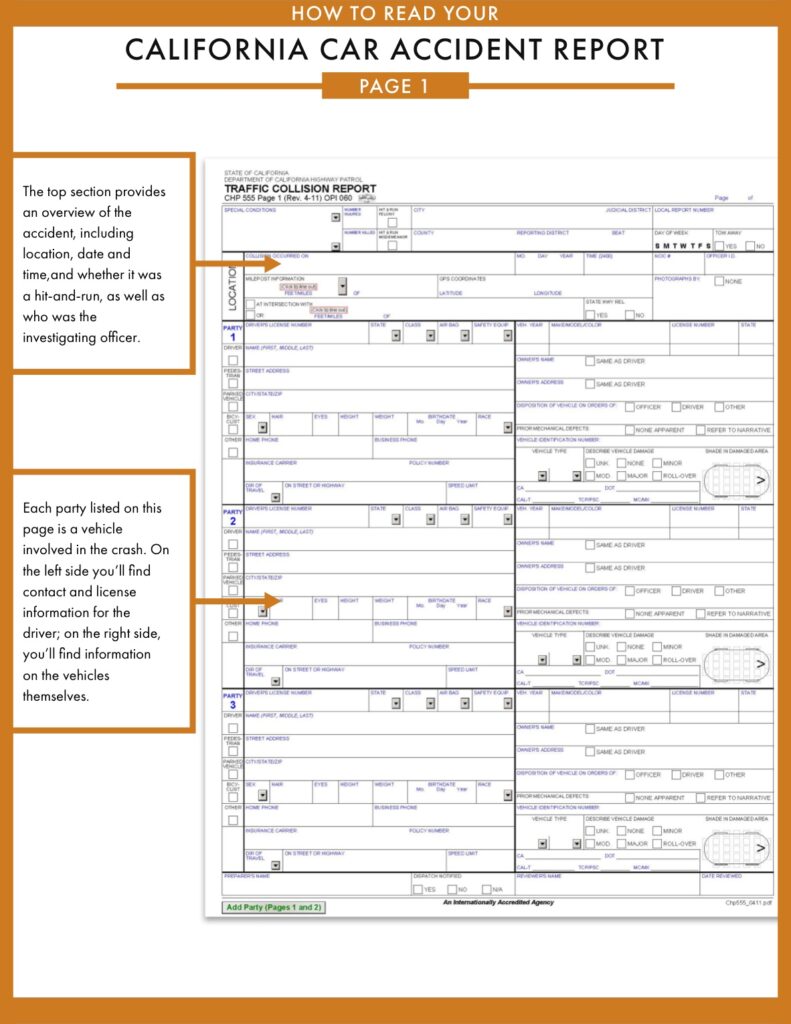
To get a California car accident report, request a copy from the agency that investigated your crash—California Highway Patrol, a city police department, or a county sheriff’s department. You generally need the crash date, location, identification, and report number if available. Review the report for incorrect statements, missing injuries, inaccurate diagrams, and disputed fault findings. If you were injured, you can speak with an attorney before the report is available. A mistake in your accident report can create problems when an insurance company evaluates your claim. An incomplete report can leave out evidence that matters. Even a report that supports your account does not establish everything you need to recover compensation. Call The Law Offices of Gerald L. Marcus at 818-784-8544 for a free consultation. We can discuss your accident, your injuries, and what needs attention before you make decisions about your claim.
California Accident Reports: Quick Answers
| Your question | What you need to know |
|---|---|
| Where do I get my accident report? | Request it from the law enforcement agency that investigated the collision. |
| Can I request a CHP report online? | Yes. Eligible parties can use CHP’s official Crash Portal. |
| How long does a CHP report take? | CHP’s portal says reports are typically available within eight business days, although individual investigations can take longer. |
| How soon can I request an LAPD report online? | LAPD currently directs requesters to allow at least 45 days after the crash. |
| Is the police report the same as the DMV SR-1? | No. They are separate documents with different purposes. |
| Can I challenge an incorrect report? | You can submit supporting information and request review through the investigating agency. |
| Do I need the report before calling a lawyer? | No. An initial consultation can take place while the report is pending. |
How Do I Get a California Car Accident Report?
Start by identifying the agency that prepared the report. The location alone does not always tell you which department handled the collision.
Check the officer’s business card, incident receipt, information exchange form, or other paperwork from the scene. Look for the agency name and report number.
A collision in Los Angeles County might have been investigated by CHP, LAPD, the sheriff’s department, or another city’s police department.
Requesting a CHP accident report
If California Highway Patrol investigated your crash, eligible parties can request the report through its online Crash Portal. CHP also accepts requests by mail or in person using Form CHP 190.
Visit the official CHP crash-report request page and follow the instructions for your preferred method.
Have the following information ready:
- Date of the collision.
- Location of the collision.
- Driver or vehicle owner’s name.
- Report number, if available.
- Your contact information.
- Identification and proof of your eligibility, as required.
People eligible to obtain a report may include involved drivers, passengers, pedestrians, bicyclists, vehicle owners, and authorized representatives.
CHP cannot provide a report prepared by another police department. Submit your request to the agency that actually investigated your accident.
Requesting an LAPD accident report
If Los Angeles Police Department investigated the collision, use the official LAPD traffic-report request page.
LAPD offers online requests for eligible reports and a mail-in process.
Its current instructions state:
- Allow at least 45 days after the collision before attempting an online request.
- Reports involving an arrest, fatality, or juvenile must be requested by mail.
- Mailed requests currently require a $19 check or money order payable to LAPD.
Follow the department’s instructions for identifying information, authorization, and mailing. Check the official page before submitting because procedures and fees can change.
Requesting a sheriff’s department or other city police report
Contact the records staff for the department that investigated your crash.
For Los Angeles County Sheriff’s Department cases, begin with the official LASD record-request guidance and the station that handled the collision.
Reports prepared by Pasadena, Long Beach, Burbank, or another city follow that department’s procedures.
Not sure which agency has your report? Give the crash date and location to the agency you believe responded and ask how to identify the correct records office.
How Long Does It Take to Get an Accident Report in California?
There is no single statewide turnaround time.
CHP’s online system says reports are typically available within eight business days. LAPD directs people to wait at least 45 days before trying its online request process.
Those timelines should not be treated as guarantees for every case. A report may still be undergoing investigation, review, or approval.
If your report is unavailable:
- Confirm that you contacted the correct agency.
- Check that the crash date, location, and party information are accurate.
- Ask whether a report exists and whether it has been approved for release.
- Keep your request confirmation.
- Ask when and how to follow up.
Do not put your injury claim on hold simply because the report is delayed. You can preserve evidence, document your losses, and get legal advice while waiting.
How Much Does a California Accident Report Cost?
The cost depends on the agency, report length, and request method.
CHP’s published paper-copy schedule starts at $10 for reports of 1–25 pages, with higher fees for longer reports. CHP directs applicants to confirm the amount with the office receiving the request.
LAPD currently lists $19 for mailed traffic-report requests. Check applicable charges through the official service when requesting online.
You can also ask your insurance company whether it already has a copy it can provide.
Official resources: CHP report instructions and fees and LAPD traffic-report requests.
Is a Police Accident Report the Same as a DMV SR-1?
No. Requesting a police report does not satisfy the separate DMV reporting requirement.
| Document | Purpose |
|---|---|
| Police or CHP collision report | Documents the investigating agency’s findings about the crash. |
| CHP 190 | Requests a copy of a CHP collision report. |
| DMV SR-1 | Reports a qualifying collision to DMV under California’s financial-responsibility requirements. |
California requires an SR-1 within 10 days when a collision causes:
- An injury, even a minor one.
- A death.
- More than $1,000 in property damage.
The requirement applies regardless of fault. A report to police or an insurance company does not replace the SR-1.
Separately, California DMV instructs drivers to report a collision involving injury or death to law enforcement within 24 hours. If an officer responded, confirm what was documented and whether further reporting is needed.
Do not confuse requesting your report with reporting your accident.
See the official DMV SR-1 instructions and California Driver’s Handbook collision requirements.
How Do I Read My California Accident Report?
Read the complete report, including available narrative pages and supplements. The first page rarely tells the whole story.
Use this checklist to identify information that may affect your claim.
Confirm the people and vehicles
Check names, license plates, vehicle owners, insurance entries, crash date, and location.
Match each party number to the correct driver, vehicle, or other involved person. An incorrect identification can cause confusion throughout the report.
A party number alone is not a final determination of legal responsibility. Read the cause findings and the explanation supporting them.
Find the primary collision factor
The report may identify a primary crash factor, also called the primary collision factor or PCF.
This is what the officer considered the main cause of the crash.
Look for:
- The party associated with the finding.
- Any Vehicle Code section listed.
- Other contributing factors.
- The explanation in the narrative.
- Whether a citation was actually issued.
A listed violation and an issued citation are different things.
Separate observations from statements
For each significant entry, identify where the information came from.
Did the officer personally observe it? Did a driver or witness report it? Is it an estimate or a conclusion?
An officer’s observation of damage to a vehicle is different from another driver’s claim that you were speeding. Both may appear in the report, but they need to be evaluated differently.
Compare the diagram with the narrative
Review road names, lanes, travel directions, impact locations, and vehicle positions.
A factual diagram may show the scene as the officer found it. Do not assume that every vehicle position represents the moment of impact or that every drawing is to scale.
If the written account and diagram appear inconsistent, flag the specific issue.
Check injury, passenger, and witness information
Look for reported symptoms, ambulance transport, the receiving hospital, passengers, and witnesses.
Compare the report with your records. Were you taken away for treatment before the officer interviewed you? Is a witness missing? Were symptoms you reported left out?
An officer’s injury classification is not a complete medical evaluation.
The CHP Crash Investigation Manual provides official explanations of the forms and reporting conventions.
What Should I Do if My Accident Report Is Wrong?
Identify the exact error and gather evidence that supports your position.
A correction request is more useful when it explains precisely what needs review.
Take these steps:
- Locate the disputed entry. Note the page and section.
- Explain the problem clearly. Describe what is inaccurate or missing.
- Gather supporting evidence. Include relevant photographs, records, video, or witness details.
- Contact the investigating agency. Ask how to submit additional information.
- Keep a complete copy. Save your submission and the agency’s response.
A misspelled name or incorrect license plate is different from a disagreement over who caused the collision. Disputed fault findings may require further investigation.
CHP uses supplemental reports to document changes and additional information. A supplement does not necessarily mean the officer will change the original conclusion.
Example: The report says your vehicle moved into another lane before impact. Your dashcam recording shows it remaining in the same lane. Preserve the original recording, including footage before and after the collision, and identify the statement it contradicts.
If an incorrect report is putting your injury claim at risk, call 818-784-8544. The Law Offices of Gerald L. Marcus can review the disputed information as part of evaluating your case.
What if the Report Says I Was Not Injured?
An early accident report may not reflect what was later discovered during medical treatment.
If symptoms appeared later or became worse, seek appropriate medical care and explain the timing accurately.
Keep records of:
- When symptoms began.
- What you reported at the scene.
- Medical appointments and diagnoses.
- Treatment recommendations.
- Work restrictions.
- Changes in your daily activities.
Do not exaggerate your symptoms or try to change your history to match the report.
A meaningful review should consider whether you were interviewed, what the officer recorded, when an injury was identified, and what the medical evidence shows.
A missing injury entry can create a dispute. It does not, by itself, establish that you were uninjured.
Does the Accident Report Decide Who Is at Fault?
The report can influence an insurance investigation, but it does not conclusively resolve every issue in an injury claim.
An officer may reach a conclusion using the information available at the time. Additional footage, witnesses, or records may need to be considered.
Your claim can involve separate questions:
- What caused the collision?
- Who may be legally responsible?
- Did the collision cause your injuries?
- What losses can you document?
- What insurance or other payment sources are available?
A report supporting your account does not automatically establish the amount of compensation you should receive.
Likewise, an unfavorable report deserves review before you assume your case is over.
Let our Los Angeles car accident lawyers evaluate the report alongside the other evidence.
Can an Accident Report Be Used in Court?
Do not assume the entire report will automatically be admitted at trial.
Hearsay rules, exceptions, and other evidentiary requirements can affect whether particular statements or findings may be used.
Your lawyer may need testimony, authenticated photographs, medical records, and other admissible evidence to establish the underlying facts.
A document that influences insurance negotiations is not necessarily admissible in its entirety in court. Building the case means identifying and preserving the evidence behind the report.
Can I File an Injury Claim Without a Police Report?
The absence of a police report does not automatically prevent an injury claim. Other evidence becomes especially important.
Contact the agency to ask whether an incident number, call record, or other documentation exists. Ask whether it accepts a later report for your circumstances.
Do not assume that a report submitted afterward will include an officer’s independent investigation.
Preserve:
- Scene and vehicle photographs.
- Driver, owner, and insurance information.
- Witness names and contact details.
- Original dashcam footage.
- Medical records and bills.
- Repair, towing, and rental documents.
- Messages concerning the collision.
Notify your own insurer promptly and comply with applicable policy requirements. If you are unsure about a statement or document request, get advice without ignoring notice or cooperation obligations.
The California Department of Insurance’s accident guide explains evidence collection and the claims process.
What Should I Do While Waiting for My Accident Report?
Protect the evidence you can access now.
Save original photographs and recordings, and back them up. Identify nearby businesses or residences that may have relevant cameras. Ask promptly about preserving footage because availability and retention periods vary.
Keep a simple record of:
- Medical visits and treatment.
- Missed work.
- Out-of-pocket expenses.
- Physical limitations.
- Communications with insurance companies.
If you receive a settlement offer, save the offer and proposed release. Before accepting, understand which claims it resolves and whether your injuries and future needs have been adequately evaluated.
You do not need a completed report to have an initial conversation with our firm. Call 818-784-8544.
Does Waiting for the Accident Report Extend My Deadline?
Do not assume it does.
California personal injury lawsuits generally have a two-year filing period, subject to exceptions. Claims involving government agencies can have substantially shorter requirements.
Police reporting obligations, DMV filings, insurance policy requirements, and lawsuit deadlines are separate.
An open investigation or ongoing settlement discussion should not be treated as permission to wait.
Review the California Courts personal injury guidance, and have the deadlines for your circumstances checked promptly.
Get Help With Your Accident Report and Injury Claim
Your report may raise questions that directly affect your recovery:
Why does it blame you? Why is your injury missing? Why is an insurance company focusing on one sentence while overlooking other evidence?
Get answers before making a decision that affects your claim.
The Law Offices of Gerald L. Marcus represents people injured in motor vehicle collisions. Attorney Gerald L. Marcus has practiced law since 1987 and previously worked as a negligence investigator.
During your free consultation, discuss:
- What happened and what the report says.
- Information you believe is inaccurate or missing.
- Evidence that needs prompt attention.
- Your treatment and missed work.
- Insurance concerns and settlement offers.
- The next steps available in your injury claim.
Have the report? Bring it. Still waiting? Bring the information you have.
Call The Law Offices of Gerald L. Marcus at 818-784-8544 or request your free consultation today.
No attorney fee unless we recover compensation. Case expenses and other obligations are addressed in the written fee agreement.
 We Don’t Back Down. We Dominate. Over $450 Million Won for Injury Victims.

